Showing posts with label systems. Show all posts

Saturday, 24 March 2012

Breaking Down the Crosby Powerplay


Added by Mike Colligan on March 24, 2012.
Sidney Crosby reminds me of Mario Lemieux at age 35.

That’s not an insult.  Probably not a compliment to the 24-year-old Crosby either.  It’s reality.
When Lemieux came out of retirement in 2000, he was a different player.  He could no longer physically dominate opponents with his reach, deceptive speed, and 6-foot-4 frame.  He had to combine what was left of those talents with his exceptional hockey IQ.

Lemieux stayed out of the high-traffic areas in an effort to save his body and became an elite playmaker.  (Goals made up over 40% of his points pre-retirement; after 2000 that dropped to 33%).


Malkin and Crosby NHL: Dec 12 Panthers at Penguins

The Penguins powerplay allows Crosby and Malkin to co-exist (Icon SMI)

Crosby has made a similar transition.  THW’s James Conley suggested last week that Crosby should consider the perimeter style of play if he wants to stay healthy long-term.  Through five games, that’s exactly the Crosby we’ve seen.

He’s had a number of great scoring chances that haven’t resulted in goals, but his playmaking has stood out the most, as evidenced by his nine assists.  Conley also pointed out that coach Dan Bylsma has surrounded Crosby with the right personnel to make this transition easier.
Crosby has spent most of his even strength shifts with Matt Cooke and Tyler Kennedy, two wingers capable of winning battles along the boards and doing the dirty work.  Bylsma has also moved Crosby to the point on the powerplay which allows him to stay out of the corners and utilize his playmaking abilities.

That switch answered one of the biggest questions surrounding Crosby’s most recent return: Can Crosby and Evgeni Malkin co-exist on the powerplay?

Since the 2008-09 season, the Penguins’ powerplay has routinely been in the bottom 10 of the NHL.  Minnesota Wild coach and former Penguins assistant coach Mike Yeo, who was responsible for the Penguins’ powerplay, was chased out of town by fans who believed Crosby + Malkin should equal domination. That simple equation hasn’t always happened for a number of physical and psychological reasons.

First, Crosby and Malkin are both left-handed.  More often than not, they tend to drift to the same areas of the ice and get in each others way (Jaromir Jagr‘s concern over the same dynamic was accurate, in my opinion)

They’re also proud players.  When Crosby and Malkin have been in the same lineup together – a rare occurrence in recent seasons – both players have insisted on having the powerplay run through them.  Many times the puck would go to Malkin, he would drift to the right halfwall where Crosby was already standing, and he’d hijack the system.  The notoriously unselfish Crosby would do the same thing.  This is one of the biggest challenges of coaching multiple superstars.

Bylsma was recently asked whether he ever considered splitting the two up, creating a 1A and 1B powerplay unit.  “Of course,” Bylsma said.  “We certainly explore all possibilities and opportunities out there. I think we’ve always felt, and strongly feel that having the best two players on the ice is the best thing to have success on our power play.”

What Bylsma didn’t say: Even the hint of Crosby or Malkin manning the ‘B’ unit would be an insult to both players.

So Bylsma made changes (with the help of assistant coach Tony Granato and his players, I suspect).  He took an inventory of the talents of his five best players:

Read rest of the awesome article here!

Thursday, 1 March 2012

Penguins Playbook: Faceoff Play Is Tormenting Opponents

What makes Dan Bylsma an elite NHL head coach?

Experts are quick to point to how the Pittsburgh Penguins have thrived the last two seasons despite serious injuries to their star players.  I think that’s just a small part of the equation.

What about teams that win and never possess that caliber of talent in the first place?  Phoenix just ran the table with a 12-0-1 record in February.  Their leading scorers are Ray Whitney and Radim Vrbata.  Coyotes head coach Dave Tippett should probably be an annual finalist for the Jack Adams Award.
After watching the Penguins play for three seasons under Bylsma, what really stands out isn’t his positive attitude.  It’s his constant innovation and creativity.  His relentless pursuit of new information.  His thoughtful line combinations, situational matchups and effective use of timeouts.
Bylsma isn’t the only one to have a firm grasp on these all-but-invisible aspects of the game, but he and his staff are certainly ahead of the curve.

The Penguins have been carried offensively by the Evgeni Malkin, James Neal, Chris Kunitz line this season.  The trio possesses a ton of skill, but part of their success that gets ignored is Bylsma’s ability to put them into scoring situations, particularly on home ice where Pittsburgh gets the last line change.
Bylsma tosses the Malkin line on the ice at the end of almost every period.  He unleashes them at the end of penalties before tired powerplay units have a chance to change.  He even manages their ice time so they are well-rested and ready to take offensive zone faceoffs coming out of the two television timeouts each period.

The Penguins have dozens of faceoff plays designed to take advantage of individual player abilities and manipulate defenders.  We discussed Malkin’s new focus on winning faceoffs a few months ago.  With the addition of a pure sniper in James Neal, Malkin’s line has suddenly become as dangerous off the draw as they are on a three-man rush up ice.

January 22 vs Washington

Over the first half of the season, Neal scored a handful of goals off the faceoff by standing and shooting from directly behind Malkin.

To Read the rest of this Article Click Here!

Monday, 16 January 2012

Core Hockey 2012 Spring Summer Camps

Hello everyone!

We have updated the website with 2012 Spring Summer camps!

We have added some new camps this year: Body Checking Camp in April, Albert Cup Prep Camp, U16 Provincial Prep Camp in July, Girls Development Camp and have added a PeeWee, Bantam and Midget/Junior conditioning Camps in August!

We brought back the Off Ice Skills Camp, Augusts Battle Camp and the Novice/Atom Skill Development Camp!

Going to be a very busy Spring/Summer for Core Hockey Training!

For more details on each of the camps, Click Here!


Friday, 6 January 2012

Strategies and Tips for 3-on-3 Hockey

Article from website School Yard Puck!

Those of you who play pick-up hockey on a regular basis are probably familiar with the fast-paced style of 3-on-3. For roller hockey players used to 4-on-4, three man hockey isn’t much of a stretch. However, if you’ve grown up playing traditional five-on-five ice hockey, you may be venturing into uncharted territory.

Designate a Stay-at-Home Defenseman

Wide open breakaways are the number one reason goals are scored in a game of 3-on-3. Having a disciplined d-man that won’t creep much further than center ice will be good insurance against a quick breakout.

Use Your Point Man

If you follow the first tip, you’ll find your point will be open for a quick shot that will get the puck to the net. Even if it doesn’t get past the goalie, there’s a good chance it will be deflected and one of the forwards will pick up the trash.

Take More Shots

Speaking of getting the puck to the net, take more shots! When you’re playing in a tighter space, nearly every spot on the ice puts you within range of the goal. Most 3-on-3 games eliminate icing and offside violations, so even if you’re shot completely misses the net, you just put the puck in your attacking zone.

Work the Area Behind Your Opponent’s Goal

Goalies have a lot to worry about in 3-on-3 hockey. A change of possession means they have to be ready for anything. With one player behind the net, the goalie has to worry about a quick wrap around, as well as two passing options.  Taking advantage of this situation can result in an easy goal.

Spread Out the Ice

Maintain a triangle formation. With your stay-at-home defender, this shouldn’t be too hard. If you’re playing up, make sure you balance out your fellow forward. Breakouts happen quick, so once you’re confident your teammate has possession of the puck, make a break for the net.

Forecheck

In 3-on-3 hockey, the neutral zone is pretty much non-existent. Don’t let your opponent get any momentum! Stop the play at it’s roots by forechecking immediately after losing possession of the puck in your attacking zone. Do not, however, get caught chasing your opponent behind his own net. Unless you have blinding speed, chances are you”ll get wasted trying to chase down the puck carrier.

Skate HARD

The nature of this game involves a lot of back-and-forth play. If you stand in one spot, it will be easier for one guy to guard you and your teammate at the same time. This is not an offensive strategy you want to have. By constantly keeping your feet moving, you’ll be harder to guard. You’ll also have momentum when an inevitable turnover occurs.

In conclusion. some of the most fun games I’ve ever played have been 3-on-3. Although I love the science and strategy involved in playing with a full roster, there’s just something about 3-on-3 that captures the raw essence of sweat-til-you-drop hockey. Have you ever played on a 3-man team? What did you think?

Tuesday, 20 December 2011

Breaking down plays in the film room

 Great Article for coaches and players!!!

There are a couple things I love taking out of film study.

A lot of athletes are visual learners but we just sit there and talk to them, wave our hands around and paint the picture as we're telling it. We [as coaches] understand what we see, but for the younger athletes, they don't understand all the little tendencies that happen on the ice with body language or the way guys turn, where the stick is. It's always nice when you can go out and have the best players in the world as an example for your athletes to observe. We go out there and collect all the highlights on NHL.com and all the goals scored. We want to look at the positive side of the goals scored and also what happened on the other side of things.

If you're the fifth overall pick, and having a tough time or struggling with something, we want to see how they handle it. It's how you bounce back and build that really strong mindset. If you make a mistake, let it go and get ready for the next shift so you don't let it snowball or basically be a downward spiral. You can't let one mistake effect you. We want to make sure the kids know they're going to make mistakes and that's why there's actually goals scored in the NHL.

Watch video and read the rest of the article here!

Monday, 19 December 2011

Backchecking by Paul O'Donnell

This is the first of a series of articles from Guest writer; Paul O'Donnell
Article was first seen on Hockey Player Tips Blog!

"Backchecking is Not a City in China"
My hockey buddies and I had heard this statement uttered more than once by coaches back in the early 70s while playing our youth hockey on Boston’s South Shore. Over time, this mildly humorous, if not somewhat ridiculous saying evolved into an ongoing joke between us when someone was caught dogging-it on the backcheck. While the phrase always seemed to result in a chuckle or two during those magical times, we were all acutely aware of the meaning that it inferred – Backchecking is not an option!

There are three major factors which prevent many players from being consistently successful on the backcheck: lack of anticipation, poor positional play and fatigue. Anyone of these issues can derail your team’s ability to generate and maintain an adequate defensive posture, in time, to prevent your opposition from successfully entering your zone at will, throughout the course of each and every game played.

Anticipation
In some ways, believe it or not, the game of hockey is a lot like chess. Both games relying on the ability of their players to tactically outman and outmaneuver their opponents during as many individual battles as possible to be successful. While significant parts of each game rely on the skills and experience of the players involved, very often, winning is decided by a player’s ability to anticipate the play farther ahead during every battle, than their opponents can.

In chess, it’s not uncommon for Masters of the game to anticipate their opponent’s tactics 15, 20 or even 25 moves ahead. In the game of hockey anticipation is measured in seconds. Even if the amount of time is only 2 to 3 seconds into the future, players who can consistently and correctly anticipate the play during individual battles as they unfold, more often than not, will be successful over their competition.

When players and coaches talk about anticipating the play, they are actually referring to reading and reacting. Play anticipation takes up a huge chunk of the overall read and reaction process. To reach any level of proficiency with respect to anticipating the play the player must first understand how they are related to one another.

To properly anticipate any play during the read and reaction process the individual player must decide how to combine his knowledge of hockey with the game situation that’s evolving at the time, and have the ability to turn it into positive, appropriate action. Unfortunately, every player’s ability to accomplish this effectively is affected by their proximity to the puck.

The ability to successfully anticipate the play is directly proportional to the reading and reacting process. In other words, the closer a player positions him/herself to the action, the more time he/she must spend reacting to the play, than anticipating the play.

To illustrate this better, think of a person taking a stroll down an unfamiliar sidewalk. While the sidewalk appears to be level and flat, the stroller should realize that there are probably cracks and frost heaves that could result in a fall, if ignored. If the walker is paying attention to their surroundings, they’ll have the time to plan a path along the way that will avoid an obstacle, should one appear. But if they’re oblivious to their surroundings and collide with the obstacle, they’ve lost the ability to anticipate and plan a different route. Their only option is to react to their loss of balance if they don’t want to take a hard tumble on the pavement.

Many young players are under the misconception that if they’re away from the play, that there’s nothing to do. While some become anxious and desert their current position because of their overwhelming need to get into the action, others turn into spectators, being mesmerized by the puck and oblivious to their surroundings.

Players need to understand, that in many cases, being on the weak side of the play is actually a plus, not a negative. It allows that player to see the big picture of the overall battle currently taking place, and anticipate multiple options, on both the offensive and defensive side of the puck.

Positioning on the Back Check
One of the major reasons for ineffective backchecking is that many players tend to place themselves in poor strategic areas of the ice when the puck changes hands. Many players away from puck, place themselves in positions in the offensive zone ahead of the puckcarrier whether puckcarrier is in solid control of the puck or not.

Some of the time, failure begins before the backcheck occurs, especially with regards to the weak side winger or F3 forward. All too often, aggressive forwards, travel father into the zone than they should, recognizing too late, that the transition is about to go bad for their team. These types of compromising positions place these forwards too far away from play to do any good in helping support their defensemen when the opposition is pressing the attack.

In hockey you always want to try to outman your opponent whenever possible, trying to keep your odd- man-down situations to a minimum. Just because you don’t have a man in the box, doesn’t mean that your team is even-up. Every time your weak side winger fails to pick up the opposition’s wide wing on their breakout, he places your team in a man-down situation.

At the very least a team on the backcheck needs to even the odds against their attackers. The most effective way to do this is to always make sure that your widest forward (F3) from the puck is always in a position to take away any passing option from their widest attacking player. But this might be difficult if F3 is standing in the low slot while the battle is being waged high along the boards, just inside the blue line. This might be a good position to be in if the battle is successful, but if the play starts ago the other way, within one or two seconds this player could easily be 40, 50 or even 60 feet behind the play, before he even has time to take a stride.

While there are an unlimited variety of ways to transition in or out of any zone, very often it comes down to a well-timed “D” to wing to center breakout or a scrum of players battling somewhere along the wall. There are instances, when time may limit an off-winger‘s ability to perfectly positioned themselves while their opponents are on a fast break. But when two teams are slugging it out along the wall, somewhere in between the hash marks and the blueline, this is the perfect time for these forwards (F3) to establish a position on the ice that will allow them to have a positive effect on the play (either offense or defense) when the puck finally comes off the boards. I call this perfect location -Neutral Positioning. I’d be very surprised if you’ve ever heard of this concept before, because it’s my concept and I’ve never written about it, until now.

Neutral Positioning
The best definition I can give for this new concept is: A location on the ice surface where support players can position themselves during any battle that will allow them to successfully support the play, whether on offense or defense, following the transition. There are locations on the ice surface, during any battle that allows supporting players to have an impact on the play, no matter what the outcome is of the battle.

For the”F3” forward, watching the battle unfold along the wall, somewhere between the hash marks and the blue line, this perfect neutral position is 30 to 40 feet directly behind the combatants, in the middle of the ice surface, somewhere between the goalposts. This position, not only gives the weak side supporting forward a bigger picture of the overall battle in progress, but it also allows him to move effectively, either north or south, with little regard to the outcome of the battle.

If F3’s teammates are successful retaining the puck, then our weak side wing has the ability to be an integral part of the attack by moving deeper into the zone with the puckcarrier. If the battle goes badly, our third forward can easily establish an effective backchecking position, either by skating with the wide winger who is looking for an easy breakout into the neutral zone or by skating into the passing lane, effectively, shutting down any chance of a tape to tape rink-wide pass.

But that’s not all; not only does he shut down that particular passing lane, but he also performs two very important services on this particular backcheck: if it’s a three player attack, by taking away that wide wing he creates and even men of situation so his defensemen can play the other two forwards man to man on their opponents attack. But more importantly, just by taking that one man out of the other team’s breakout, he has dramatically shrunken the other team’s ability to rally an attack by literally shrinking the available passing surface for the attackers.

The reason that this is so important is that the full size (or the width) of the rink is only useful if there is an available passing outlet to the other side of the rink. By taking away the wide winger on the weak side of the ice, the ice surface shrinks to the width of the next widest available passing option. Usually, the next supporting player is another wing or center (F2) who is the closest player to the puck carrier (F1). If this player is only 15 or 20 feet away from the puck carrier and the puck carrier is moving up the boards, the only available ice surface on the breakout is also, only 15 or 20 feet wide, instead of 80 or 85 feet. Within 2 to 3 seconds our fictitious player has performed 3 crucial tasks - in one felled-swoop.

Another very important added benefit to neutral positioning, in this case, is that while our hypothetical F3 player is waiting for the play to unfold, he should be doing absolutely nothing, except keeping his head on a swivel for any opposing players who are trying to gain a positional advantage. This would be the perfect time for a player to rest and catch his breath, if only for a few seconds, while trying to anticipate possible outcomes of the scrum along the wall.

Fatigue
Of the three pieces to the backchecking puzzle that I describe in this article, probably the most important is the fatigue factor. Fatigue is the X factor that is the fuel, or should I say, lack of fuel that saps the body’s energy and a players’ will to win.

Coaches who consistently shift their lines for more than one minute at a time, during an average game, are not doing their players any favors; and unknowingly, may actually, be assisting their competition. The average shift for an NHL player is 40 to 45 seconds. If the greatest hockey athletes in the world are unable to consistently skate for more than a minute, how can any coach justify long shifts for the average youth hockey player.

Ice time is the carrot as well as the stick for any and every hockey coach. For those players who are affected by selective hearing, there are 3 very easy solutions: tell’em, bench’em, suspend’em.
While I would like to say more about the fatigue factor, there are far too many issues to consider on this very important subject. In a later column I plan to devote an entire article to this crucial and very often misunderstood aspect of the game.

Due to an abundance of requests for copies of my articles, I will be entering the blogging world soon. I hope to have it up and running by the end of January so please be patient. As always, I look forward to your comments, good, bad or ugly at: paul@neckuphockey.com


Paul O'Donnell writes his syndicated column, Understanding Hockey from the Neck up for Chicago's Hockey Stop Magazine. Paul grew up playing hockey in the Greater Boston Area and played his college hockey at Salem State College in Salem, Massachusetts. He has been coaching in the Chicagoland area for the past 25 years. Send your comments,good, bad or ugly to: paul@neckuphockey.com

Friday, 25 November 2011

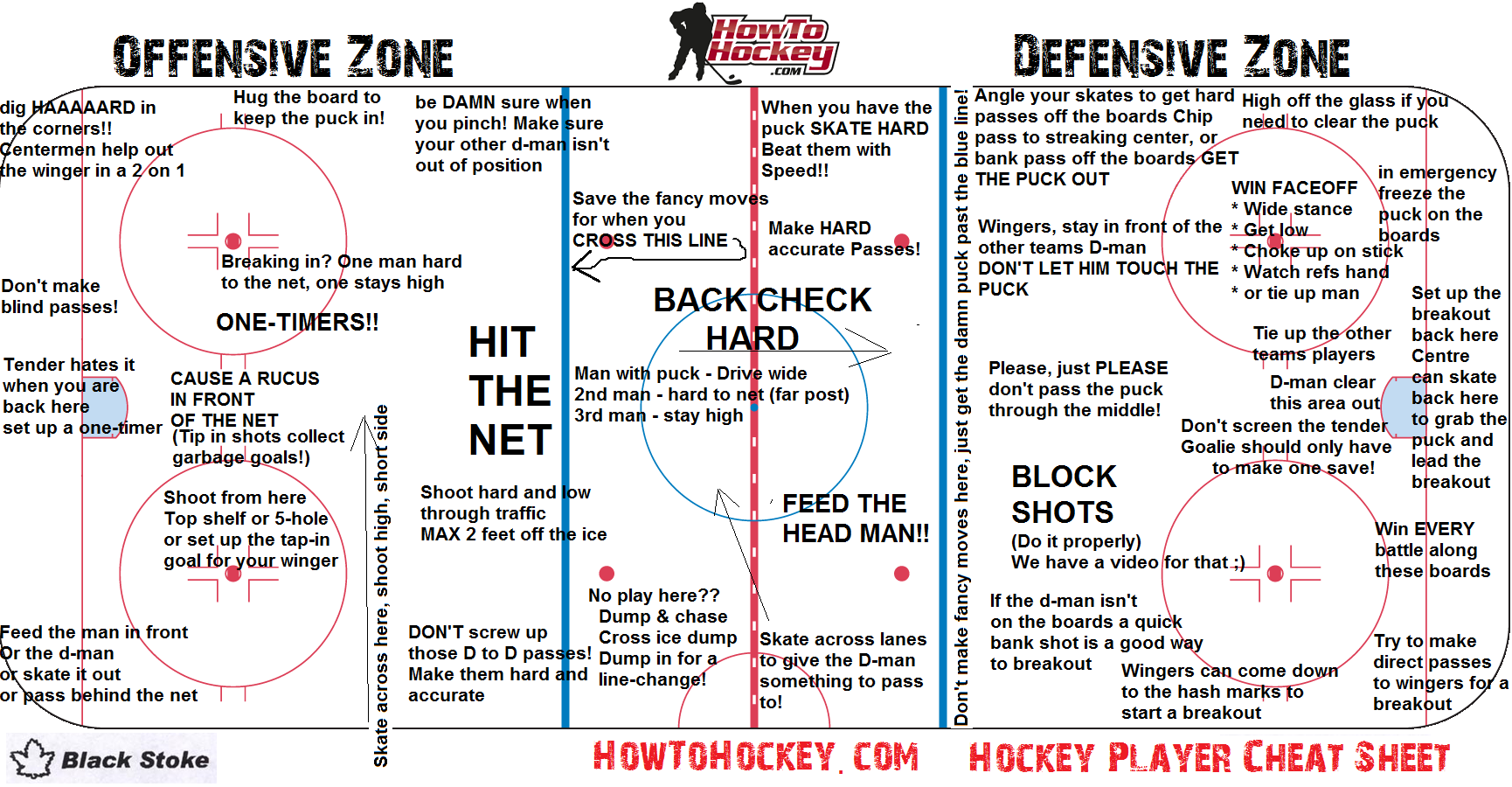
The Coaches Cheat Sheet

How To Hockey - Great site for a wide range of topics about hockey!

Lets be honest, there is a lot to learn when it comes to positioning in hockey and you might have heard it 20 times but some of us just aren’t verbal learners. For all the visual learners out there I have created the hockey cheat sheet. This is an all encompassing guide that pretty much covers everything that your coach will yell over the boards at you. If you like this guide be sure to share it with your friends

Click Here for the Hockey Cheat Sheet

Wednesday, 28 September 2011

Basic Neutral Zone Regroup Options

From Hockeyshare.com - great resource site for coaches and players

The ability for a team to properly execute a neutral zone regroup can mean the difference between generating a scoring opportunity and giving up a scoring opportunity.  In this video, we cover four basic neutral zone regroup tactics to help your team transition from the neutral zone to the offensive zone.

Option #1: Post Up -- Wings post up just inside the blue line along the wall for quick outlet options. Center curls strong-side for a secondary pass.  This is a good option for less experienced teams, or teams with defensemen who don’t have strong puck-movement skills and ice vision.

Option #2: Double Curl -- The strong-side wing curls to the middle of the ice while the center curls toward the strong-side wall. The weak-side winger can post up for a tertiary outlet option.  This option creates more offensive movement through the neutral zone, so defensemen need to have solid passing abilities, as they’re attempting to hit a cutting player instead of one at a stand-still.

Option #3: Weak-Side Stretch -- The strong-side wing posts-up, center curls strong-side. The weak-side wing starts up ice, then cuts back across the far blue line looking for a stretch pass outlet.  This option requires defensemen with strong ice vision and passing abilities.

Option #4: Strong-Side Stretch -- The weak-side wing posts-up, center curls strong-side.  The strong-side wing starts up ice, then cuts back across the far blue line looking for a stretch pass outlet.  This option requires defensemen with strong ice vision and passing abilities.


Wednesday, 4 May 2011

Tampa Bay - The 411 on the 1-3-1

Much has been made of Guy Boucher's implementation of a 1-3-1 neutral zone checking scheme. Below the jump I'll explain how the 1-3-1 works, why the Bolts use it,  how they've used it against the Caps, and how to beat it.

Before the jump, I'd like to acknowledge the work of Fehr and Balanced, who provided all of the videos for this FanPost as well as numerous content suggestions and edits. Any errors are my own.


Great article - Check the rest out by clicking HERE!